













 Email
Email SMS
SMS Whatsapp
 Web Push
 App Push
 Audience Sync for Ads
 Popups
 Channel A/B Testing
  Control groups Analysis
 Frequency Capping
 Funnel Analysis
 Cohort Analysis
 RFM Analysis
 Signup Forms
 Surveys
 NPS
NPS Landing pages personalization
  Website A/B Testing
  PWA/TWA
 Heatmaps
 Session Recording
 Wix
Wix Shopify
 Magento
 Woocommerce
 eCommerce D2C
  Mutual Funds
 Insurance
 Lending
  Recipes
  Knowledgebase
 Developer Docs
 Product Updates
 App Marketplace
 Academy
 Ebooks
 Case Studies
 Blog
Blog Templates
 Afreen Sheikh
📌 Quick Answer: Best Segment Alternatives in 2026
Twilio Segment is the most widely used CDP for event collection and data routing — but its MTU-based pricing model, engineering dependency, and Twilio acquisition complexity are pushing teams to look for alternatives. Segment pricing jumped significantly last year and most teams need to add Unify and Engage as separate paid add-ons to get full functionality, making the true cost 2–3× the base plan price.
- Best overall CDP + MA + AI in one: NVECTA (NVECTA) — unified CDP, multi-channel automation, AI-driven insights, and no engineering dependency
- Best for lifecycle marketing & omnichannel: CleverTap or Braze
- Best for B2C mobile-first engagement: MoEngage or Plotline
- Best for enterprise customer experience: UserInsider or Netcore Cloud
Are you looking for good alternatives to Segment to enhance your customer data management and engagement strategies?
You’re in the right place! If you’re exploring the best alternatives to Segment for analytics, there are several powerful tools available that can help you collect, unify, and activate your customer data more effectively—often with greater flexibility, pricing options, or specialized features tailored to your needs.
This blog will guide you through sevenoutstanding Segment alternatives that excel in unifying customer data, creating personalized experiences, and driving business growth.
Whether your goal is to leverage advanced analytics, ensure seamless multi-channel communication, or gain comprehensive customer insights, these alternatives have you covered. Let’s dive into the best Segment alternatives and find the ideal solution for your business needs.
Why teams are looking for Segment alternatives in 2026
Segment earned its reputation by solving a real problem — instead of separately instrumenting every analytics and marketing tool, you instrument once and route data everywhere.
That pitch still holds. But the reasons teams look beyond Segment have become more concrete and more common over the last couple of years.
MTU pricing gets expensive fast
Segment charges per Monthly Tracked User rather than per event or per seat. That sounds reasonable at the start — but as your audience grows, the cost scales in ways that catch teams off guard.
Segment pricing has increased significantly in recent years, and most teams that want full functionality need to add Unify (identity resolution) and Engage (audience building and journeys) as separate paid add-ons.
The result: what looks like a manageable base plan ends up running 2–3× the headline price once you actually use the platform properly. For growing companies, that math eventually stops working.
Marketing teams cannot self-serve
Segment was built for engineers. Complex tracking setups, custom transformations, and advanced audience logic require developer involvement.
Marketing teams who want to move quickly — launch a campaign, update a segment, test a new trigger — are stuck raising tickets and waiting on engineering queues. For companies where marketing needs to operate independently, that dependency is a real bottleneck.
Segment is a data pipe, not a full platform
Segment collects events and routes them to other tools. That is its core strength — and also its core limitation. It does not autonomously decide what message to send to whom, it does not run campaigns, and it does not replace a marketing automation platform.
If you’re evaluating alternatives at a deeper infrastructure level, understanding flexibility in product setup:
—such as RudderStack vs Segment—can be particularly useful, as it highlights how different platforms approach data control, deployment models, and customization. Similarly, a Comparison between Bloomreach and Segment CDPs can offer valuable insight into how platforms differ in areas like personalization capabilities, commerce integration, and real-time data activation—helping teams choose a solution that aligns more closely with their business goals.
RudderStack vs Segment can be particularly useful, as it highlights how different platforms approach data control, deployment models, and customization.
Then there is one resource that can help you accomplish that goal, a Comparative analysis of mParticle and Segment can help clarify differences in data infrastructure, identity resolution, and activation capabilities. Ultimately,
If you want personalisation, journeys, and activation, you need Segment plus at least one or two additional tools, each with their own contract, integration overhead, and data sync requirements.
Teams that want to reduce that complexity naturally look for platforms that combine the CDP and execution layers.
Twilio acquisition complexity
Segment’s acquisition by Twilio added enterprise contract complexity and shifted parts of the product roadmap toward Twilio’s existing communication infrastructure. For teams that do not need Twilio’s telephony stack, that added overhead — in both pricing and product direction — can feel like paying for things you will never use.
Data residency and compliance concerns
Segment stores customer profiles and event history on its own infrastructure. For teams in regulated industries — banking, healthcare, insurance — operating under GDPR, HIPAA, or India’s DPDP Act, that creates a compliance challenge. When your data needs to stay within specific geographic or infrastructure boundaries, a platform that stores it externally becomes harder to justify to legal and security teams.
7 Best Segment Alternatives and Competitors
1. Nvecta
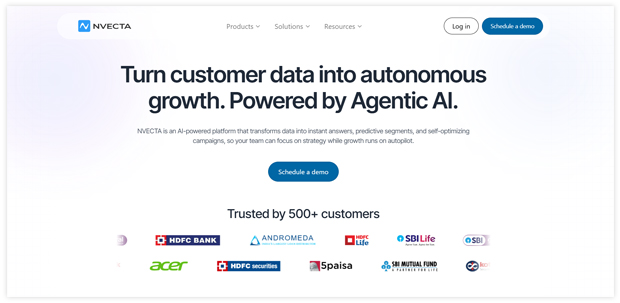
Nvecta is a leading alternative to Segment. It offers a comprehensive customer data platform (CDP) that excels at unifying and understanding customer data from multiple sources.
With its robust features, NVECTA empowers businesses to create a 360-degree view of each customer, enabling personalized and relevant experiences that drive engagement and growth.
Features
- Multi-Channel Marketing: Reach your customers through email, SMS, push notifications, and more, ensuring consistent and comprehensive communication.
- User Lifecycle Management: Manage customer journeys effectively by providing personalized experiences based on user behavior and lifecycle stages.
- Dynamic Journey Builder: Create and automate customer journeys with a robust tool that provides personalized experiences at every stage of the customer lifecycle, helping to nurture leads and boost loyalty.
- A/B Testing: Experiment with different marketing strategies and optimize campaigns for better performance through A/B testing.
- Unified Customer Profiles: Consolidate data from websites, apps, CRM systems, and marketing platforms to gain a holistic view of each customer, including their demographics, behaviors, and interactions with your brand.
- Comprehensive Segmentation: Classify customers based on their demographics, behaviors, and interests, allowing for more precise marketing campaigns and relevant messaging.
- RFM Analysis: Segment customers by recency, frequency, and monetary value to tailor personalized experiences and maximize engagement.
- Real-Time Data Handling: Process customer data instantly to make informed decisions based on the latest information.
- AI-Driven Insights: Utilize artificial intelligence for features such as personalized recommendations, churn predictions, and optimization of marketing channels and timing.
- Funnel Analytics: Monitor customer progress through sales and marketing funnels, identify drop-off points, and take corrective actions to improve conversion rates.
- Predictive Analytics: Leverage predictive tools to anticipate customer behavior and uncover new engagement opportunities.
- Automated Messaging: Send personalized messages that align with customer preferences and behaviors, enhancing satisfaction and loyalty.
- Third-Party App Integration: Connect seamlessly with a variety of third-party applications and platforms to enhance functionality and data collection.
- Expert Support: Benefit from dedicated account managers who provide personalized support and assistance.
- Real-Time Data Processing: Process customer data instantly, enabling prompt decision-making based on the latest information.
Pros
- Comprehensive data collection
- Seamless third-party integration
- Powerful customer segmentation
- Personalized messaging capabilities
- Automated workflow processes
- Dedicated customer support
2. CleverTap

CleverTap is an advanced marketing automation platform renowned for its user lifecycle marketing and omnichannel engagement.
It provides real-time analytics, A/B testing, and campaign personalization, allowing businesses to tailor messaging and promotions to specific user segments. This data-driven approach enhances user acquisition, retention, and growth strategies.
Features
- Real-Time User Analytics: Monitor user behavior for actionable insights.
- User Segmentation: Engage users based on specific segments.
- Multi-Channel Marketing: Reach users via push notifications, email, SMS, and in-app messages.
- A/B Testing: Optimize campaigns through experimentation.
- RFM Analysis: Segment users by recency, frequency, and monetary value.
3. Braze

Braze is a powerful customer engagement platform designed for omnichannel marketing, user lifecycle management, and customer support.
It helps B2C brands foster user loyalty and drive growth through meaningful interactions. Braze enables businesses to reach users via email, push notifications, SMS, and in-app messaging, creating personalized journeys based on behavior and preferences.
Features
- Omnichannel Marketing: Engage users on preferred channels like email and SMS.
- User Lifecycle Management: Create personalized journeys based on behavior and preferences.
- A/B Testing: test content and messages to optimize engagement.
- Real-Time Analytics: Gain insights into user behavior and measure campaign effectiveness.
- Automated Experiences: Deliver personalized experiences across different user lifecycle stages.
4. MoEngage

MoEngage is a powerful customer engagement platform that helps businesses create personalized experiences across various channels. It offers essential tools like marketing automation and customer journey mapping, allowing companies to connect with their audience effectively.
With its multi-channel capabilities, MoEngage enables communication through email, SMS, push notifications, and in-app messages. Advanced analytics and A/B testing features help optimize campaign performance and enhance user insights.
Features
- Multi-Channel Campaigns: Reach customers via email, SMS, and more.
- Journey Mapping: Automate personalized customer journeys seamlessly.
- Advanced Analytics: reflecting customer engagement and behavior.
- Personalization Tools: Customize messages to match individual preferences.
- Campaign Optimization: Boost performance through A/B testing.
5. Plotline

Plotline is a customer engagement platform designed for B2C companies. It enhances in-app experiences to boost user activation and conversions. It also allows businesses to create native overlays and embeds that integrate seamlessly with their app’s design.
With a no-code builder, real-time segmentation, A/B testing, and omnichannel engagement capabilities, Plotline helps businesses optimize user interactions and track campaign performance effectively.
Features
- No-Code In-App Experiences: Build overlays without coding knowledge.
- Real-Time Segmentation: Personalize engagement based on user actions.
- A/B Testing: Optimize in-app experiences with experimentation.
- Multi-Channel Integration: Engage users via push notifications, SMS, and email.
- Performance Analytics: Track and evaluate campaign effects on user behavior.
6. UserInsider

UserInsider is a customer data platform (CDP) designed for enterprise-level customer experience. It unifies customer data and activates it to personalize journeys across all touchpoints.
The platform excels in creating comprehensive customer profiles and offering personalized journeys—making it easier to explore segment alternatives in depth within your existing content.
Automated marketing workflows streamline engagement, while real-time analytics track performance and optimize campaigns. A/B testing capabilities ensure tailored messaging for each user based on AI-driven predictions.
Features
- Automated Marketing: Streamlined workflows for better engagement.
- Personalized Journeys: AI-driven targeted messaging and offers.
- Customer Profiles unified: Comprehensive view covering all touchpoints.
- Optimize campaigns: Test and formulate strategies with A/B testing.
- Real-Time Analytics: Instant performance tracking and insights.
7. Netcore Cloud

Netcore Cloud is a customer engagement platform that personalizes journeys across multiple touchpoints. It offers omnichannel communication tools and data analytics to understand the audience better.
Businesses can connect with customers via email, SMS, push notifications, and WhatsApp. Marketing automation simplifies tasks, while unified customer data and analytics provide a broader view for optimized performance.
Features
- Omnichannel Communication: Engage customers across email, SMS, and more.
- Personalized Content: craft messages based on user preferences.
- Unified Customer Data: Comprehensive customer data view.
- Marketing Automation: Automate tasks and personalize campaigns.
- Performance Tracking: Detailed analytics and reporting for optimization.
Segment alternatives compared — all 7 at a glance
Before diving deeper into any one platform, here is a side-by-side view of all seven alternatives. The columns that matter most are the technical level required and the key differentiator — because the right choice depends heavily on whether your primary user is an engineer or a marketer, and what gap in Segment’s offering you are actually trying to fill.
| Platform | Best For | Technical Level | Key Differentiator vs Segment |
|---|---|---|---|
| ⭐ NVECTA (NVECTA) | All teams — CDP + MA + AI in one platform | Low — no-code for marketers | Combines CDP, multi-channel marketing automation, AI-driven insights, RFM analysis, and predictive analytics in one unified platform — no separate MA tool required |
| CleverTap | Lifecycle marketing and mobile engagement | Low–Medium | Real-time analytics and RFM segmentation built in — strong for retention-focused marketing teams |
| Braze | B2C omnichannel engagement at scale | Medium | Enterprise-grade omnichannel execution with journey builder — stronger activation layer than Segment alone |
| MoEngage | Multi-channel campaigns with journey mapping | Low–Medium | Purpose-built customer journey automation with strong mobile channel support — more marketing-led than Segment |
| Plotline | In-app experience and B2C activation | Low — no-code builder | No-code in-app overlays and real-time segmentation — strong for product and growth teams without developer dependency |
| UserInsider | Enterprise customer experience personalisation | Medium–High | Comprehensive unified profiles with AI-driven journey personalisation — goes beyond Segment’s data routing |
| Netcore Cloud | Omnichannel communication including WhatsApp | Low–Medium | Native WhatsApp integration alongside email, SMS, and push — strong for markets where WhatsApp is a primary engagement channel |
How to choose the right Segment alternative for your team
The right choice depends on two things: what your team actually needs that Segment is not delivering, and who in your organisation will primarily own the platform.
Before making a decision, reviewing the key differences between mParticle and Segment in 2025 can provide additional clarity on how leading CDPs compare in terms of data architecture, the process involves identity resolution and activation.
It becomes easy to decide whether your organization requires a pure data pipeline or an integrated platform.
Here is a practical framework based on those two dimensions.
Choose NVECTA (NVECTA) if:
You want CDP and marketing automation working from the same data layer without managing two separate platforms and two separate contracts. NVECTA combines unified customer profiles, real-time segmentation, AI-driven insights, and multi-channel campaign execution in one place.
It is designed so that marketing teams can operate self-sufficiently — no developer dependency for campaign changes, segment updates, or journey modifications. If reducing the total number of tools in your stack is a priority alongside reducing cost, this is the strongest all-in-one option on this list.
Choose CleverTap or MoEngage if:
Your primary focus is lifecycle marketing and you need strong retention mechanics — RFM segmentation, behaviour-based triggers, and mobile channel depth — without needing a separate CDP layer first. Both platforms are more marketing-led than Segment and allow teams to move faster on campaign execution. CleverTap tends to be stronger on analytics depth; MoEngage tends to be stronger on journey visualisation and ease of use for non-technical marketers.
Choose Braze if:
You are a B2C company at scale that needs enterprise-grade omnichannel execution with a sophisticated journey builder. Braze is the strongest pure engagement platform on this list — it handles complex user lifecycle scenarios well and integrates with a wide range of data sources. The trade-off is cost and implementation complexity; Braze is typically a better fit for teams with dedicated marketing ops resources.
Choose Plotline if:
Your primary bottleneck is in-app experience and your product or growth team needs to launch in-app overlays, onboarding flows, and feature announcements without engineering tickets for every change. Plotline’s no-code builder is its standout feature. If your core need is web or app activation rather than cross-channel campaign orchestration, it is worth evaluating seriously.
Choose Netcore Cloud if:
WhatsApp is a primary engagement channel for your audience — particularly relevant for businesses in India and other markets where WhatsApp messaging outperforms email for customer communication. Netcore’s native WhatsApp integration alongside email, SMS, and push gives it an advantage in markets where Segment’s Western-centric channel stack does not cover the channels your customers actually use.
Conclusion
To stay ahead in the ever-changing world of marketing and customer engagement, having the right tools is essential. These alternatives to segment provide a wide array of features and capabilities to meet various business requirements.
With tools for automation, personalization, advanced analytics, and multi-channel communication, these platforms help businesses improve customer engagement and boost growth.
Frequently Asked Questions
1. What is the best free alternative to Segment?
Among the platforms on this list, NVECTA offers the most accessible entry point for teams looking to move away from Segment’s MTU-based cost model. For fully open-source options not covered here, RudderStack is the most direct free alternative — its open-source core includes 25 million events per month with unlimited sources and destinations. The trade-off with RudderStack is that setup and maintenance require engineering resources. For marketing-led teams that want self-serve capability without developer dependency, NVECTA is the stronger practical choice.
2. Why is Segment so expensive?
Segment’s pricing is based on Monthly Tracked Users (MTUs) rather than events or seats. As your audience grows, costs scale directly — and often unpredictably. The bigger issue for most teams is that the base plan does not include full CDP functionality. Segment’s identity resolution product (Unify) and audience building layer (Engage) are separate paid add-ons, meaning teams that need the complete platform typically pay 2–3× the headline base price. Segment pricing has also increased significantly over the past two years following the Twilio acquisition.
3. Does Segment have a free plan in 2026?
Segment offers a free tier with limited functionality — it allows up to 1,000 Monthly Tracked Users and provides access to basic event collection and a limited number of destinations. For most businesses beyond the early startup stage, the free tier is too restrictive for production use.
The free plan does not include identity resolution, audience building, or access to Segment’s full destination library. Teams outgrowing the free tier often find the jump to paid pricing substantial, which is one of the main triggers for evaluating alternatives to Bloomreach for CDP solutions.
4. What is the difference between Segment and a full CDP?
Segment is primarily a data collection and routing platform — it collects behavioural events from websites, apps, and servers, and forwards them to analytics, marketing, and advertising tools. A full CDP goes further: it resolves customer identities across touchpoints, builds persistent unified profiles, creates dynamic audience segments, and activates those segments across channels directly. Segment has added CDP capabilities (Unify for identity, Engage for audiences) but these are separate products with additional costs. Platforms like NVECTA, CleverTap, and Braze combine data unification with campaign execution in a single platform — which is what most teams actually need when they say they want a “CDP”.
5. Which Segment alternative is best for marketing teams without engineering support?
NVECTA is the strongest option for marketing-led teams that need to operate without constant engineering involvement. Its no-code journey builder, self-serve segmentation, and AI-driven insights are designed specifically so that marketers can build, launch, and optimise campaigns without raising developer tickets. CleverTap and MoEngage are also strong in this regard — both have been built with marketing usability as a priority. Segment itself, by contrast, was built primarily for engineering teams and requires developer involvement for most non-trivial use cases.
